

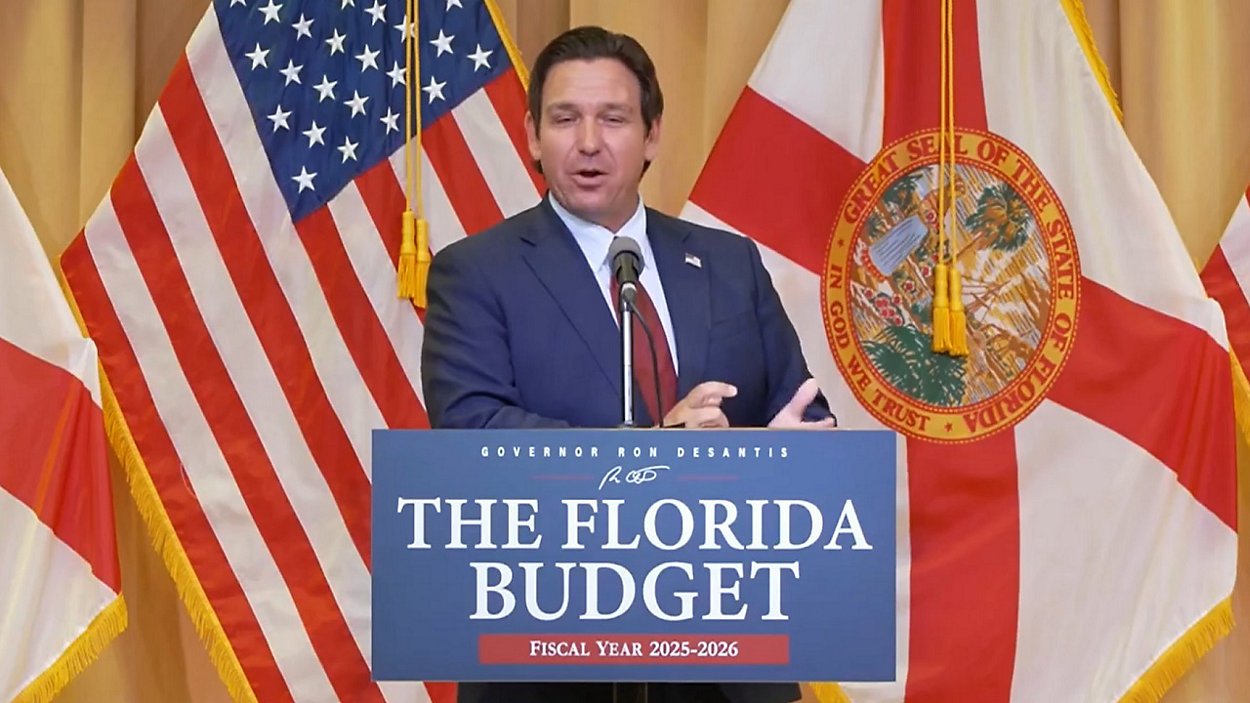

Florida’s property tax fight is usually covered as a self-contained story. Home values surged, tax bills climbed, a popular governor offered relief. From there it becomes an ordinary fiscal debate: how deep should the cut go, who absorbs the loss, can local budgets take it.
But nearly half of all Voting Rights Act cases filed since 1982 challenged at-large local elections — county commissions, school boards, city councils. That law is what forced hundreds of Southern local governments to adopt single-member districts and give minority voters someone to actually elect. Local government is not a small stage. It is where representation was won, one commission at a time, over forty years.
Keep that in mind, because everything else here happens at that level.
Two things are bundled under “the DeSantis property tax bill.”
The first is a pair of laws signed in June 2026. SB 4-F strips local governments of a tool they used to raise their maximum tax rate and imposes supermajority — in some cases unanimous — vote requirements before a city or county can exceed the baseline “rolled-back” rate. HB 1329 forces local governments to run a formal exercise identifying spending to cut, and to publish more budget detail. Neither cuts a single taxpayer’s bill. Both make it harder for a local majority to set its own budget.
The second is Amendment 3, on the November ballot. It raises the homestead exemption toward eventual elimination of non-school homestead property taxes. State economists put the hole at roughly $5 billion in year one, climbing toward $12 billion within five years.
That is the number. Here is the thing. A county absorbs a cut like that in the places with no constituency — the rural fire station that goes from three shifts to two, the school nurse who now covers four campuses, the bus route that runs twice a day instead of six times. Nobody lobbies for the bus route. The money does not disappear when the tax does; it reappears as sales taxes, fees, rents, and things that stop arriving.
The amendment also writes a fixed list of allowable spending into the state constitution, and authorizes future elimination steps requiring no further vote of the people.
Supporters — the governor, CFO Blaise Ingoglia, legislative leaders, and the free-market James Madison Institute, whose study and polling underwrote the case — call it taxpayer protection. Critics, including Republican local officials, call it a shift rather than a cut. The Tax Foundation, which has never met a tax it liked, called the design highly distortionary.
Florida is not improvising. Researchers tracked more than 650 state preemption bills in a single recent year — states stripping powers from their own cities and counties. Texas passed HB 2127, nicknamed the Death Star law, blocking cities from regulating across entire fields unless the state authorizes it; struck down in 2023, reinstated on appeal in 2025, and now being used to void dozens of Dallas ordinances. Mississippi expanded a state-run police force across most of Jackson, a city over eighty percent Black, and created a court system with state-appointed judges and prosecutors. Similar efforts targeted St. Louis, Nashville, Montgomery. Georgia built a mechanism to sanction prosecutors it deems rogue. DeSantis simply removed two elected state attorneys.
Minimum wage, paid sick leave, tenant protections, gun rules — all preempted, state by state, session by session.
The property tax package is this same maneuver conducted through the budget instead of the police or the courts. The DOGE audits of local governments, the supermajority thresholds, the mandated cuts, the constitutionally frozen spending list: each one moves budget authority up and away from the county building.
Near-identical bills appear in a dozen states in the same session because they are often not written in those states. The American Legislative Exchange Council, founded in 1973, convenes corporate lobbyists and state legislators to draft template bills behind closed doors. Legislators pay nominal dues. Corporate members pay considerably more and vote on the models. Between 2010 and 2018, ALEC models were introduced roughly 2,900 times; over 600 became law. It maintains preemption templates. It is heavily funded by the Koch network. Around it sits the State Policy Network, a web of state-level think tanks.
The James Madison Institute — author of the property tax study the governor leaned on — is a State Policy Network affiliate. The Texas Public Policy Foundation, where that study’s economist built his career, and which is now suing Dallas to enforce the Death Star law, is another. Florida and Texas are not merely running parallel plays. They are drawing on the same apparatus.
Now set the property tax bills beside the other things the same people did in the same window.
The amendment constitutionalizes a spending list and authorizes future cuts that need no further public vote. SB 4-F raises the vote threshold for local bodies to act. The DOGE audits pressure specific local governments, disproportionately Democratic-led. Two elected state attorneys, removed. HB 1205, passed in 2025, makes citizen ballot initiatives nearly impossible: a million-dollar bond, a ten-day return window, criminal penalties for holding more than twenty-five signatures, residency and citizenship rules for the people who gather them. The Florida Freedom Fund spent roughly $35 million in public money campaigning against the abortion and marijuana initiatives. And a 2019 law blunted the voter-passed restoration of felon voting rights by conditioning it on paying off all fines — a condition a federal court compared to a poll tax.
Every one of those moves a decision away from wherever a popular or local majority could reach it, and toward a state-level chokepoint the incumbent party controls. Every one raises the cost of reversal.
But the thing to look at is the initiative law, because of what it did not do. It did not abolish the citizen initiative. It made the channel nearly impassable for citizens while leaving it entirely open to the Legislature — which then used that very channel to put the property tax amendment on the ballot.
The ballot device is fine when the state wields it. It is throttled when the public might wield it against the state.
That asymmetry is the whole argument. An efficiency project binds the efficient and the inefficient alike. An integrity project audits both parties’ counties. A budget-discipline project constrains Tallahassee the way it constrains Broward. This one bends one direction, every time, under whatever justification is available that season. Sometimes it is taxpayer relief. Sometimes it is election integrity. Sometimes it is fiscal responsibility. The reasons rotate. The direction does not.
What the machine reliably produces is not lower taxes. It is a shrinking number of places where a local or opposition majority can change anything, and a rising cost of undoing what has already been set. Jacob Grumbach’s state democracy index found that partisan polarization barely predicts democratic backsliding at the state level. Unified Republican control strongly does. The driver is not division. It is a program.
Someone will object that nobody intended this. Probably some of them didn’t.
A man who buys a gun and a shovel and drives to his brother-in-law’s house will tell you he wasn’t thinking clearly. We do not characterize the act from his account of his feelings. We read it from what he did, in what order, and infer design. Attempted murder is punished as murder’s near relative not because it worked — it didn’t — but because the shape of the conduct discloses its purpose whether or not the outcome cooperates.
The same holds in the other direction. Jim Crow’s purpose was not made uncertain by the fact that the Voting Rights Act eventually beat it. The defeat tells you about the resistance. It tells you nothing about the machine.
None of this rests on new ground. Cities are creatures of the state under Dillon’s Rule, possessing no inherent sovereignty, which is what makes preemption legally available at all. And the most-cited episode of American democratic collapse — the end of Reconstruction — was accomplished largely by moving power away from local, often Black-majority governance, upward to the state, through poll taxes, literacy tests, and state control of local institutions.
Local control and government closest to the people were conservative watchwords for a century. They have been inverted, and even sympathetic observers have said so.
The instruments are gentler now because the crude ones are illegal. A structure moving power away from local, urban, disproportionately minority majorities cannot use hoods and literacy tests; those get struck down. So the same vector runs through bond requirements, supermajority thresholds, signature rules, and audits — instruments that are facially neutral and individually defensible. The mildness is not evidence against the function. It is the shape the function is required to take once the blunt version is unavailable. Deniability is what the legal environment selects for.
Which raises the obvious question about the thing doing the selecting.
On April 29, 2026, the Supreme Court decided Louisiana v. Callais six to three and gutted Section 2 of the Voting Rights Act for redistricting — the last significant federal guardrail after Shelby County removed preclearance in 2013. The dissent called Section 2 all but a dead letter.
Look at how it was done. Callais makes partisan gerrymandering a lawful shield for racial vote dilution. Say you submerged those voters for party rather than race, and the claim collapses. Where racially polarized voting and partisan gerrymandering coexist — which is everywhere this matters — vote-dilution claims become effectively unbringable. Race, laundered through party, now blessed from the top.
And the doctrinal core of it: Callais shifts the test from effects to present-day intentional discrimination, instructing courts to give much less weight to historical evidence and ongoing consequences.
An intent test does not protect anyone from discrimination. It immunizes discrimination, because effects are provable and intent never is. The man always says he wasn’t thinking clearly. Moving the question from what a law does to what its authors were feeling is not a tightening of the evidentiary standard. It is the removal of the guardrail, performed at the level of what courts are permitted to see.
The executive prong ran in parallel. At the president’s urging, Texas and other states conducted mid-decade redistricting in 2025 to manufacture House seats. Callais released the brake, and the snap-back was immediate: Florida passed new maps within hours. Tennessee eliminated its only majority-minority district within days. Others followed. States that had been forced into fair maps abandoned them the moment the force lifted — which tells you what the fairness was.
A third line of attack is quieter and aims at who can enforce the law at all: cases testing whether private plaintiffs may bring Section 2 suits. You do not have to repeal a statute if nobody has standing to invoke it.
Which brings it back to the county commission.
Section 2 was never only about congressional maps. It was the instrument that democratized local government across the South — the thing that turned at-large elections, which submerge minority voters in a citywide majority, into single-member districts where they can actually elect someone. Gut it, and at-large vote submergence becomes available again at exactly the level where preemption, prosecutor removals, initiative throttling, and now budget authority are all being consolidated.
The federal guardrail and the local-control fight were always the same fight, at two altitudes.
What the structure does is insulate incumbent power from majoritarian and local reversal, with racially and geographically uneven incidence, using whatever instruments current law still permits. That is true whatever any architect says he was thinking, true whether or not it survives the next court, and true despite the fact that it now wears a suit.
Preemption is not a partisan monopoly; blue states preempt red cities. What is concentrated on one side is the particular configuration — constitutionalizing the outcome, throttling the initiative, dismantling the guardrail — backed by a national model-bill network.
And none of it is finished. The attacks on the guardrails are themselves the evidence. Nobody spends this much effort dismantling checks that no longer threaten them.
Whether it completes is a question about the counter-power, and that has not been answered yet.
Sources include the Florida Executive Office of the Governor, CBS News, WLRN, the Florida Phoenix, the Florida Policy Institute, the Tax Foundation, the James Madison Institute, the Texas Tribune, the Texas Observer, Route Fifty, Stateline, NPR, ProPublica, the Center for Public Integrity, the Brennan Center, SCOTUSblog, the Campaign Legal Center, and the Court’s opinion in Louisiana v. Callais.